


The Lovett Baseball Scrapbook Part 1: A Scrapbook’s Hidden Sporting First? Boston Origins for Football and Soccer
By Kevin Tallec Marston; Co-authored by Mike Cronin
Published: July 2026
There’s a surprising connection between Massachusetts’ history and the world’s most popular sport.
 This summer Boston hosts the Semisesquicentennial and the FIFA World Cup, but few visitors will connect the national commemoration of America with the celebration of the world’s game. Luckily, Revolutionary Spaces’ collection presents the perfect opportunity to highlight surprising sporting stories that add to the long list of Massachusetts’ firsts.
Tucked away in the archives is a piece that holds some sporting secrets: a thickly bound scrapbook credited to James D’Wolf Lovett. The 200 pages reveal a multitude of news clippings, and letters, acting as a window into Boston’s fascinating history from its calls for liberty in ’76 through to the 20th Century.
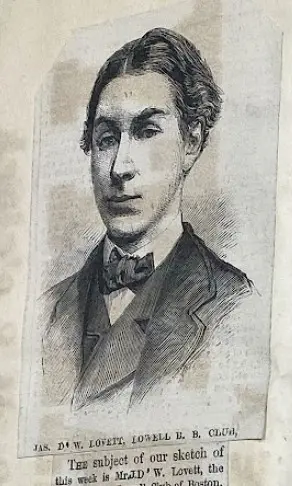
In the middle of carefully glued and annotated baseball articles, we find a sketch of an otherwise ordinary young man. The description, however, lauds Lovett, the “gentlemanly exponent of the attractive features of our National Game.”1
Pictured: Who was baseball star J.D’W. Lovett, the man who had “no superior?”
James D’Wolf Lovett scrapbook (detail), 1861-1945
MS0118
Collection of Revolutionary Spaces
Too Talented to Forget
James D’Wolf Lovett (1844-1935) was the captain and pitcher of the Lowell Club of Boston, a group of men who played an early version of baseball. Lovett is known for his contributions to the sport just before it transformed into the national pastime.2
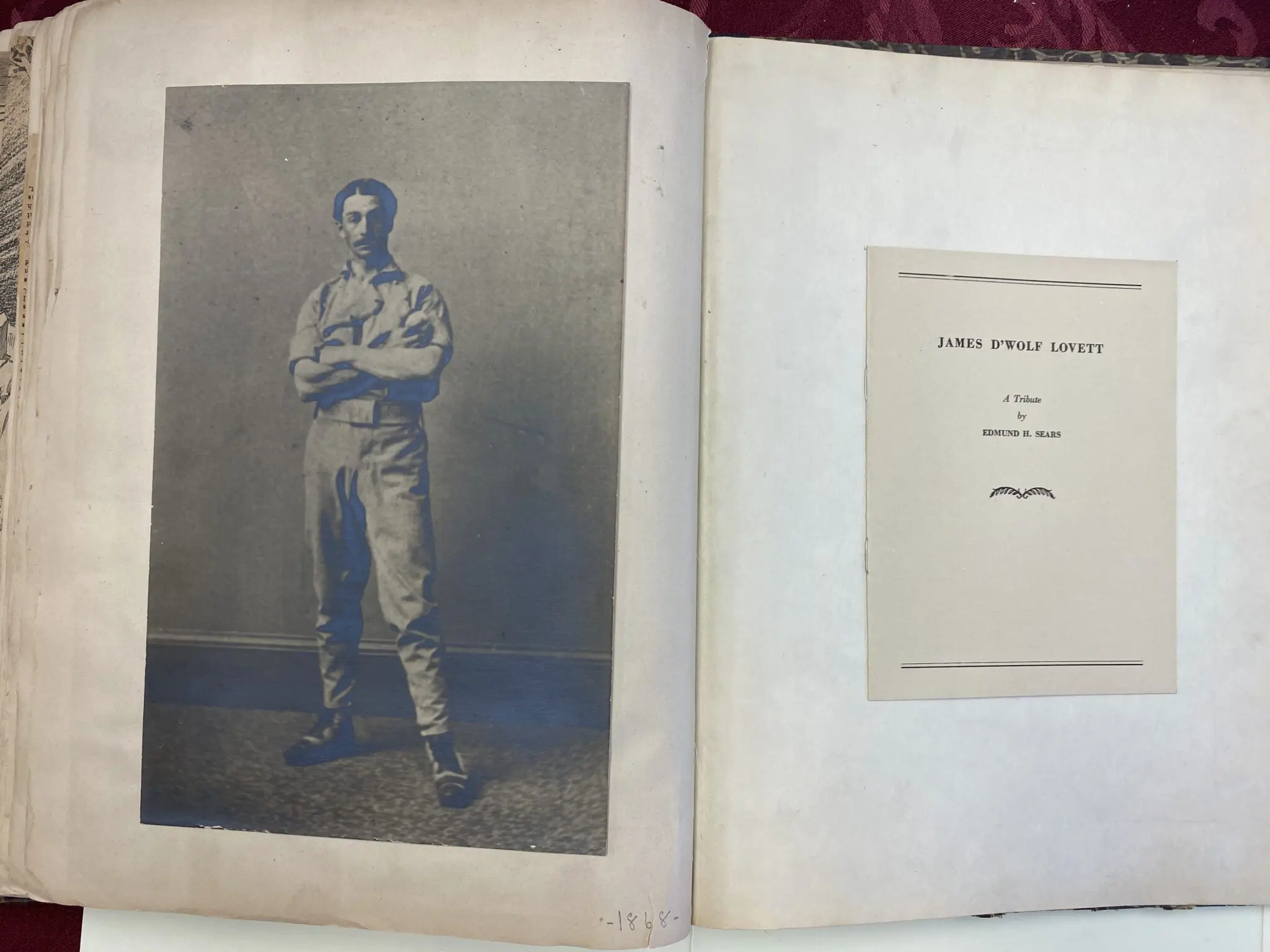
Unlike his Lowell clubmates who went on to found Harvard baseball in 1866, Lovett was one of the rare Beacon Hill and Back Bay boys not to attend the university. But this did not stop him from being one of the only non-Harvardians mentioned in the school’s sporting encyclopedia. He was even credited for helping design the first diamond north of the Charles near the Washington Elm on Cambridge Common.3 A testament to his gentlemanly amateur status, he was selected in 1897 for two prestigious ‘Old Timer’s Games,’ one as the only non-college graduate to play against former pros captained by A. G. Spalding and another alongside Spalding and other old stars, with Henry Chadwick throwing the first pitch.4 Lovett was remembered as the “ideal gentleman sportsman…the Shakespeare of ball players,” to quote his contemporary Edmund Sears.5
Pictured: Lovett’s funeral exercises (1935) opposite Lovett’s portrait (1868). Sometime after his death, his daughter Alice donated her father’s memories of a now disappeared Boston so that they might be preserved for posterity.
James D’Wolf Lovett scrapbook (detail), 1861-1945
MS0118
Collection of Revolutionary Spaces
A Glimpse into Old Boston
If nostalgia could be a smell, then the aroma of old Boston, a Brahmin Boston, rises off the scrapbook’s pages. They record the city’s sporting and leisure culture through a generation whose brimming adolescence was colored by the Civil War. While most of the clippings cover baseball, others chronicle rowing, boxing, gymnastics, and the vibrant Longwood cricket community where Lovett played alongside ex-baseballer ‘gentleman professional’ George Wright. The scrapbook also contains images and postwar events through the Gilded Age and into the 1920s.
 Lovett’s own memories of old Beacon Hill before and during the city’s urban transformation are preserved in the Back Bay itself. His papers, held by the Massachusetts Historical Society, include a typescript memoir featuring everything from character building—as a youth, Lovett faced a ball-induced broken window in his own Washington-cherry-tree moment—to memories of watching how the “‘Back Bay’ was eventually to be filled in and converted in terra firma”.6
Returning to the scrapbook, articles recount major anniversaries like the 1872 World’s Peace Jubilee and that same year’s Great Fire. Other clippings mark societal change such as when the Athenaeum’s historic proprietorships were sold off to the public, the library having already lost its uniquely gentleman-only preserve to the admission and (even!) employment of women. Reading the bound volume paints a vivid picture of the passing of a pastoral city into new industrial America.
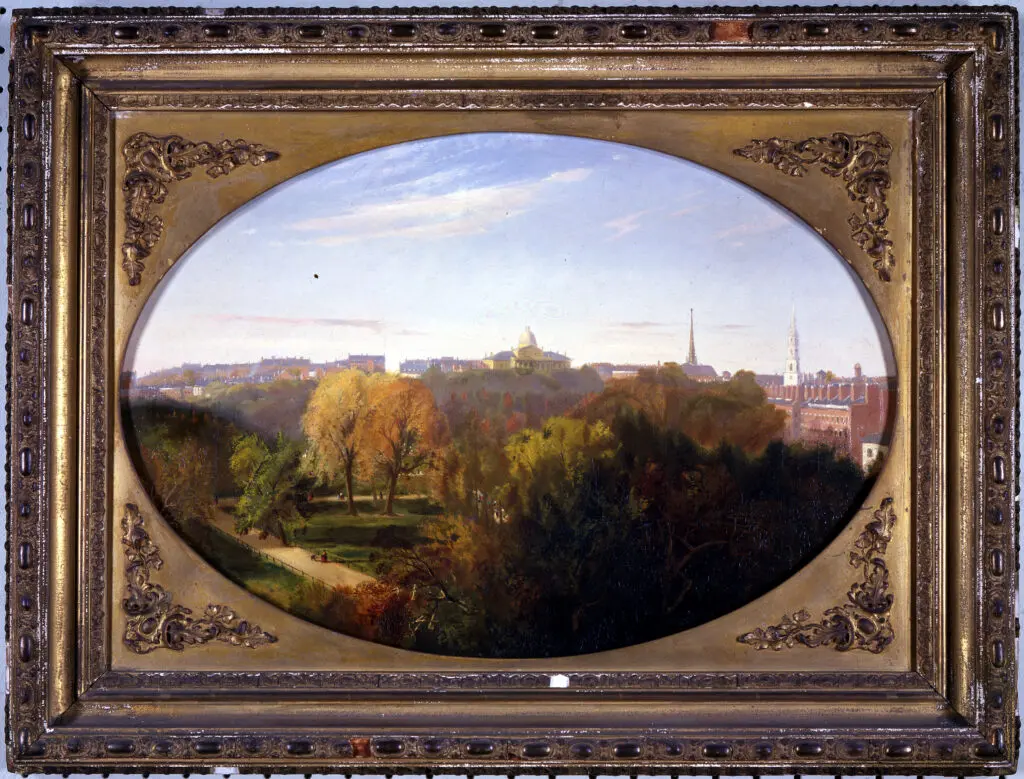
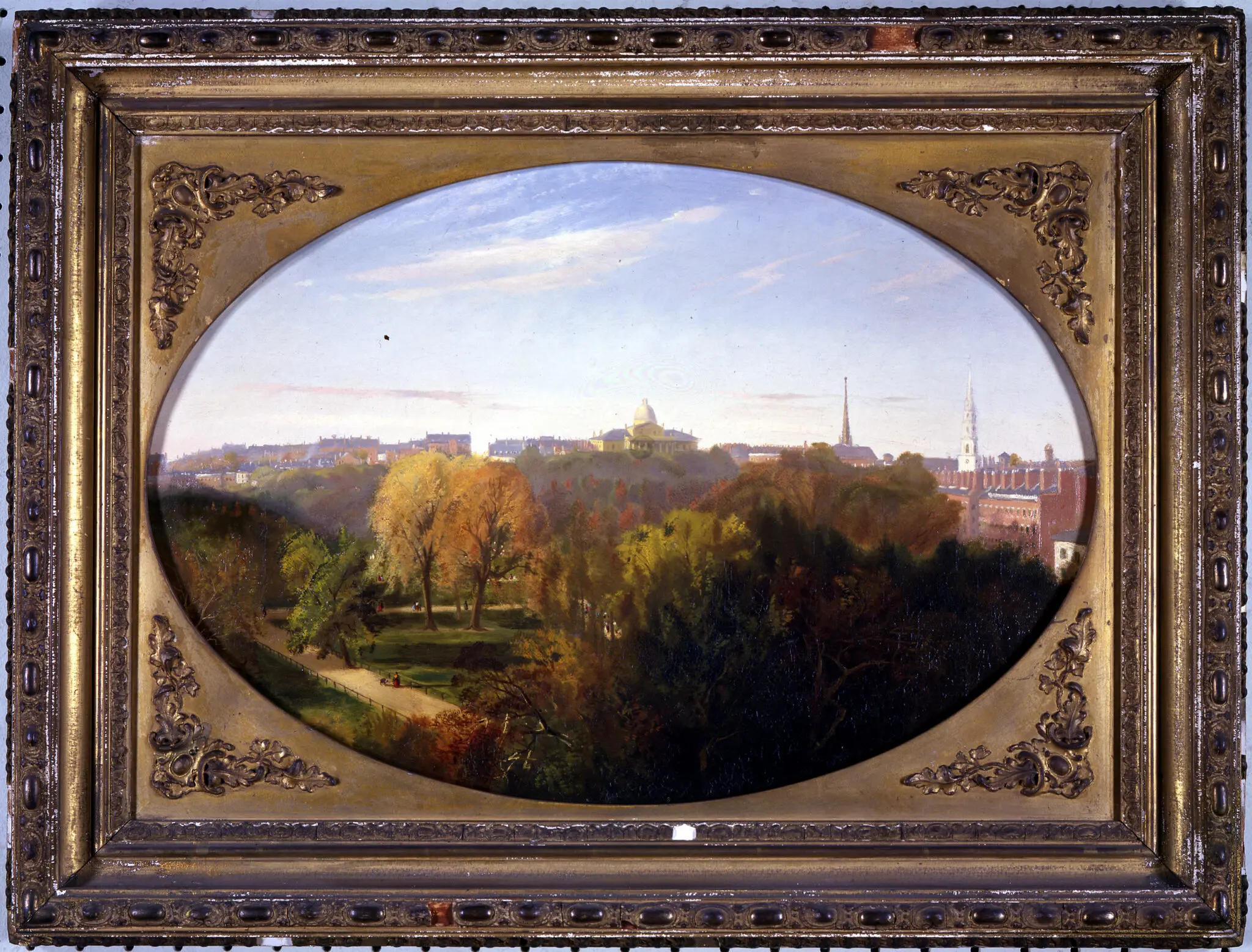
Pictured: The bucolic Public Garden is captured on canvas in another Lovett household donation. It was on this green, now central to a twentieth century metropolis, where Lovett and his boyhood friends had supposedly invented a pair of sports.
Boston Public Garden, ca. 1846
1941.0012
Collection of Revolutionary Spaces
A Founder of Foot-Ball
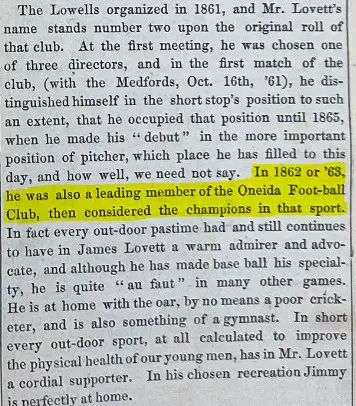
The battle between baseball’s local Massachusetts rules and the New York ‘import’ took place too early for Lovett to have founded the national pastime. However, Lovett played another round ball game in the 1860s, one that occupies the spot on the timeline between local tradition and organized modern sports. His scrapbook provides an early reference to this evolutionary leap. An unnamed article circa 1868 notes that “in 1862 or ’63, [Lovett] was also a leading member of the Oneida Foot-Ball Club, then considered the champions of that sport.”7
When matched with the newspaper record, there is evidence for a well-known club, organized undoubtedly in the same culture of free association as Lovett’s baseball club. The press in 1863 and 1864 provides accounts, albeit limited, of games “played by the Latin and High Schools (“Romae fuit”) and the Oneida Foot-Ball Club” and confirms the club as city champions.8
Pictured: James D’Wolf Lovett scrapbook (detail), 1861-1945
MS0118
Collection of Revolutionary Spaces
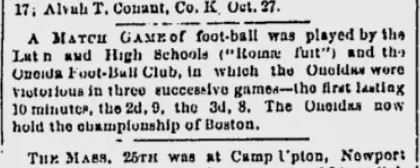
The most comprehensive research on early games in America reveals mostly school-based teams and one-off mentions such as festival or Thanksgiving day games; structured clubs only really became common in the 1880s.9 Lovett’s Oneida club stands out as the earliest ongoing inter-school organization and Boston’s first champions.
Pictured: James D’Wolf Lovett scrapbook (detail), 1861-1945
MS0118
Collection of Revolutionary Spaces
But, which Football?
The Oneida Foot-Ball Club has since been claimed by United States soccer and American football as an essential part of both of their founding narratives. How can this be?
In the mid-19th century, football was what historian Tony Collins calls a “universal game” before it branched off into distinct codes.10 Differentiating from cultural rituals like Shrovetide games between villages, this ‘foot ball’ was a common athletic practice among (mostly) boys and young men with localized school traditions in the British Isles. In the 1860s, a need for standardization superseded provincial preferences. Rule governing associations were formed and a separate rugby game broke away after 1871. But these United Kingdom developments occurred precisely during the years that the United States was engulfed in, and emerged out of, civil conflict. A similar fine tuning of local American rules only began after colleges permitted the game again at the turn of the 1870s.
As such, Lovett and his fellow Oneidas inhabit a unique entry in the timeline. In the midst of the Civil War, they organized a club to play a ‘foot ball’ that predated the English Football Association (1863), the first United States printing of its rules (1866), and the formation of the English Rugby Union (1871). The Oneidas played their own game, dribbling the ball with their feet and kicking to score, but also carrying that round ball under specific circumstances. The Oneidas were perfectly placed on the cusp of history. Some were directly involved in the transformational Harvard-McGill (1874-75) games that birthed American college football while others had direct links to soccer—with one Oneida Robert Apthorp Boit’s cousin who became the first American to win the now famous English FA Cup in 1872.
The contemporary records are thin for the club, with little preservation in comparison to early Massachusetts baseball. If it were not for Lovett’s scrapbook and a couple newspaper articles, the Oneida club may have been lost to history like much of daily life’s unrecorded leisure activities.
In the second installment of this blog article, we will explain how this memory was preserved and even mythologized.
-
- The original clipping comes from “Our Base Ball Illustrations,” Frank Leslie’s Illustrated Newspaper, 13 October 1866, 52-53
- Phil Bergen, “Early Baseball in Boston: Lovett of the Lowells,” The National Pastime 16 (1996), 62-68.
- John Blanchard, ed., The H Book of Harvard Athletics 1852-1922 (Cambridge: Harvard Varsity Club, 1923), 150.
- “Old-Timers Prepare For 1879 Ball Game,” (unnamed and undated newspaper clipping); “Old-Timers To Play,” Boston Daily Globe, 20 June 1897, 9.
- Edmund H. Sears, James D’Wolf Lovett – A Tribute (privately printed, 1935), 3.
- James D’Wolf Lovett, unnamed memoirs typescript, November 1933, folders 19, 20, 21, 22 (writings 1–4), James D’Wolf Lovett papers, 1896–1935, Massachusetts Historical Society, 21.
- “James D’W Lovett,” unnamed newspaper clipping, annotated date 1868.
https://archive.org/details/chartersgenerall00mass/page/514/mode/2up - “A Match Game,” Boston Evening Transcript, 9 November 1863, 3.
- Melvin I. Smith, Evolvements of Early American Foot Ball: Through the 1890/91 Season (Bloomington, IN: AuthorHouse, 2008).
- Tony Collins, How Football Began: A Global History of How the World’s Football Codes Were Born (London: Routledge, 2018).
 Kevin Tallec Marston
Tallec Marston is CIES Senior Research Fellow and Visiting Lecturer at De Montfort University’s International Centre for Sport History & Culture (UK). He has taught for over twenty years on the FIFA Master, lectures at the University of Neuchatel (Switzerland), and serves as current president of the Society for American Soccer History (SASH)
Mike Cronin
“Inventing the Boston Game: Football, Soccer and the Origins of a National Myth” (UMass Amherst) was the honorable mention for the North American Society for Sport History (NASSH) 2025 Book award.