


The Lovett Baseball Scrapbook Part 2: From Scrapbook Page to Mysteriously Changing Boston Monument
By Kevin Tallec Marston; Co-authored by Mike Cronin
Published: July 2026
What happens when a sports team plays an active role in shaping how they are memorialized?
Can you imagine hearing about a public monument being changed not just once, but twice? What if that monument already reflected a stretched truth, and happened to stand on nearby Boston Common? Building on the previous installment about the James D’Wolf Lovett Scrapbook, this blog post explores what happens when carefully crafted heritage takes some surprising historical turns. Here, we examine how Lovett’s scrapbook memories were preserved—and their significance transformed—manufacturing his Oneida Football Club into yet another one of Boston’s founding firsts.
Scrapbook Memory to Published Story
There is a nearly 10-year gap in Lovett’s scrapbook leading up to 1906. But then, spread over two pages, a careful reader can unfold a tribute to Boston’s sporting past.1
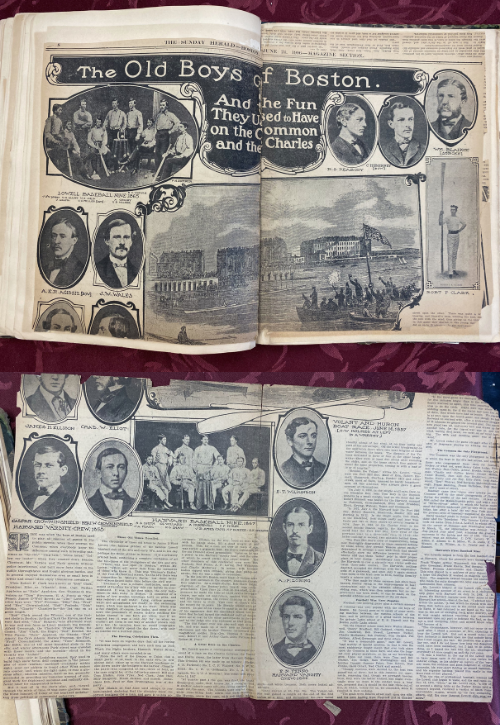
A summer book review from The Sunday Herald recounts Lovett’s freshly printed Old Boston Boys and the Games They Played (also a part of Revolutionary Spaces’ collection). While the review does not cite the organization by name, Lovett’s collective memoir does include one chapter on the Oneida Football Club, hitherto unknown to the public. After an initial subscription issue, Lovett’s book was then published by Little, Brown & Company and distributed across the country, ensuring all of America knew Boston was a city of indelible sporting traditions.
During that same temporal gap in Lovett’s scrapbook, a wave of social and urban transformation swept over Brahmin Boston, threatening to wash away old American memory. Erected as a dam against these tidal pressures, cultural institutions sprouted in defense. Historical organizations, such as Revolutionary Spaces’ predecessor, the Bostonian Society and the Society for the Preservation of New England Antiquities (now Historic New England), started collecting the seemingly banal material culture of old New England as precious evidence of a passing world.2 From this Massachusetts preservationist movement, swelled city-wide commemoration efforts—like the 1921 Plymouth Tercentenary celebration which feted Massachusetts as the origin of national history—all part of the ongoing battle with rival old Virginia for ownership of the country’s founding narrative.3
James D’Wolf Lovett scrapbook (detail), 1861-1945
MS0118
Collection of Revolutionary Spaces
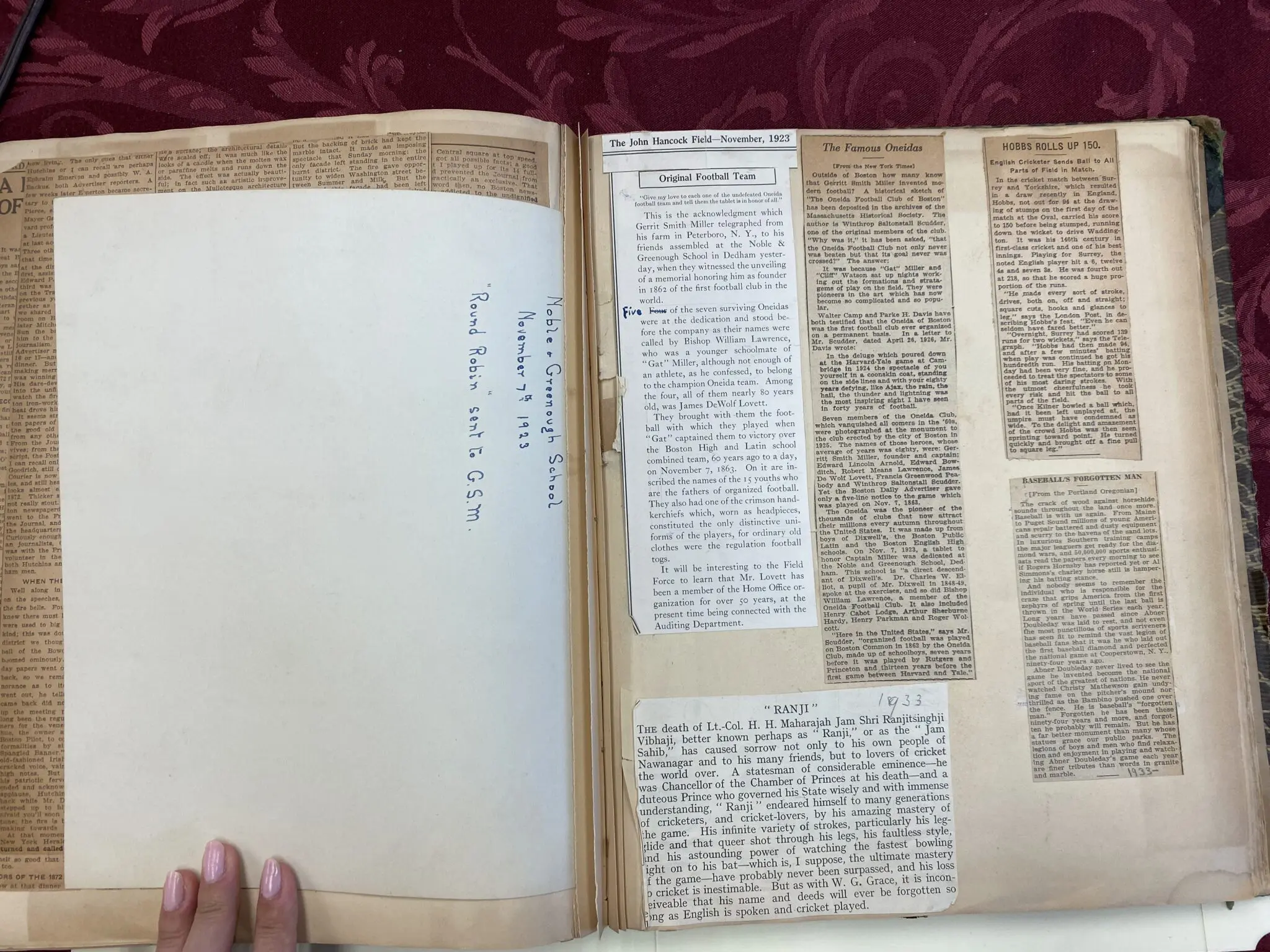
This was the zeitgeist that inspired Lovett and his old friends to donate their old round ball to SPNEA in 1922. Less than a year later, Lovett helped orchestrate recognition for their old club captain, Gerrit Smith Miller. Designed as a didactic exercise for the schoolboys of Noble & Greenough at their newly inaugurated Dedham campus, a small ceremony honored Miller with an engraved plaque and recognized the club members as the “fathers of organized football.”4
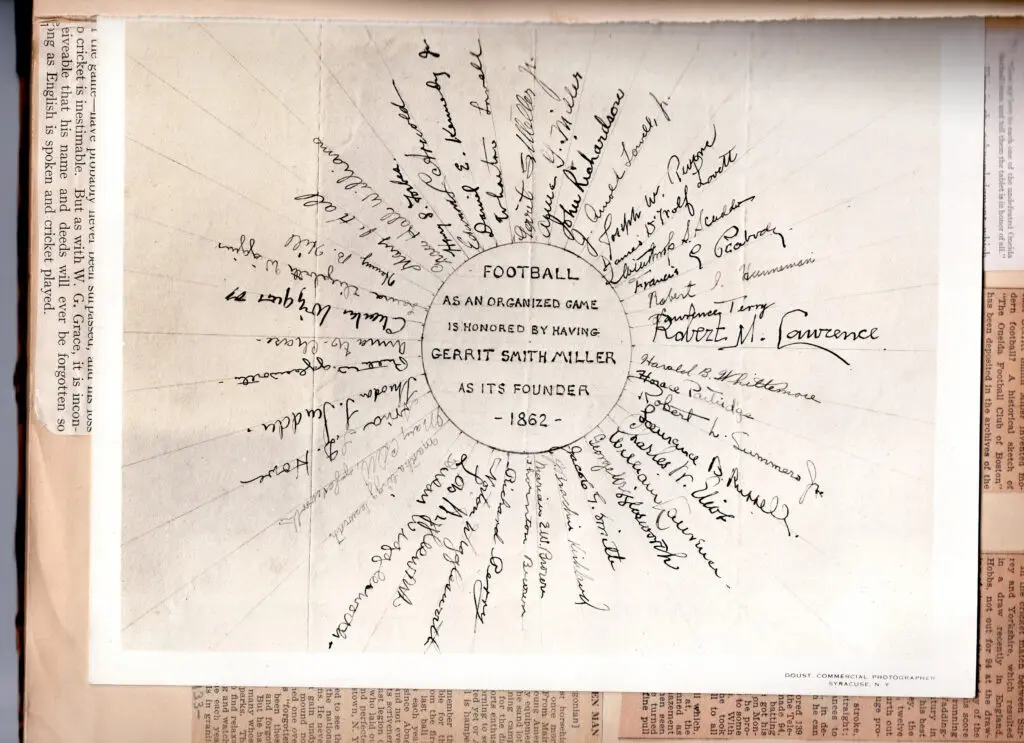
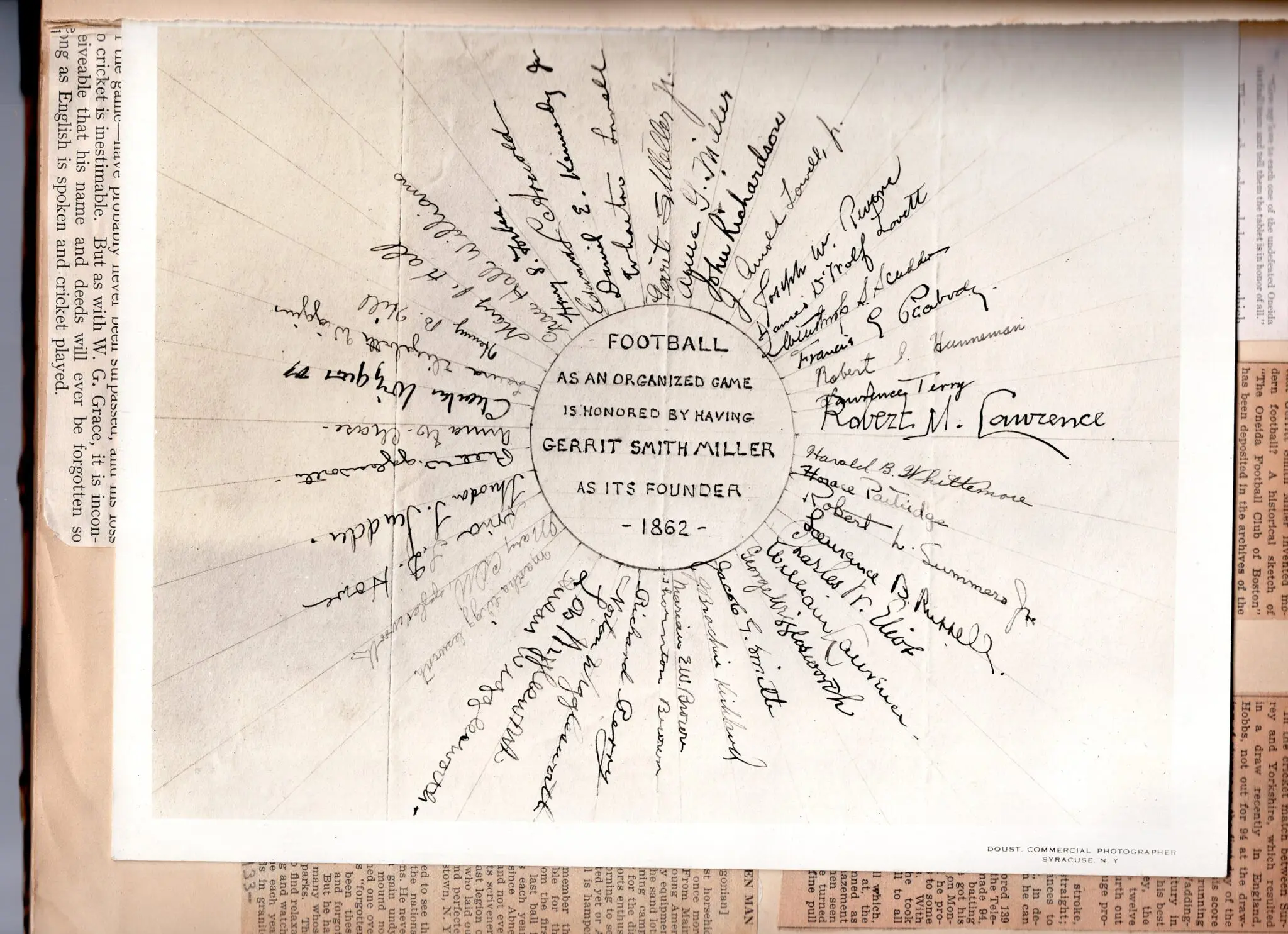
Beyond the clipping from the John Hancock Field newsletter (the company where Lovett was still an auditor), the scrapbook includes an intricate “Round Robin” signed by ceremony attendees. Among the illustrious names were former Harvard president Charles W. Eliot, Bishop William Lawrence, and Paul Revere’s great-grandson, Joseph Warren Revere.5 Destined as a private gift to the absent Miller, the memento reveals the still intimate nature of the commemoration. It was not yet a script to a national origin story.
James D’Wolf Lovett scrapbook (detail), 1861-1945
MS0118
Collection of Revolutionary Spaces
From Boston Archive to National First
Within just a few page flips in Lovett’s scrapbook, the surviving Oneidas go from locals to legends and make full page news. In 1925, seven of them embarked on a monument project to enshrine their history on Boston Common. By riding the momentum of their renewed fame, Lovett’s crew was able to unveil their stone tablet before the end of the year.
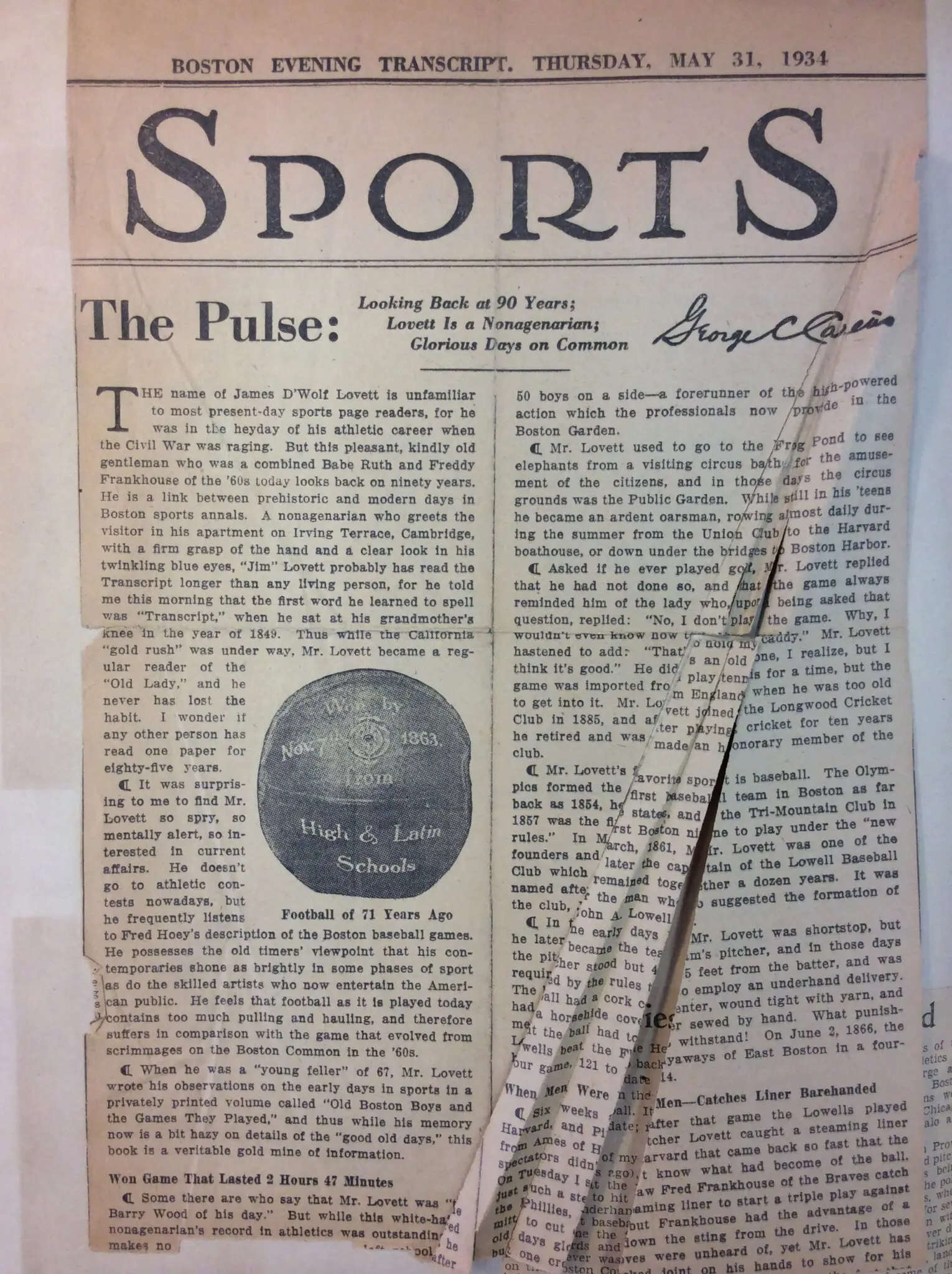
James D’Wolf Lovett scrapbook (detail), 1861-1945
MS0118
Collection of Revolutionary Spaces
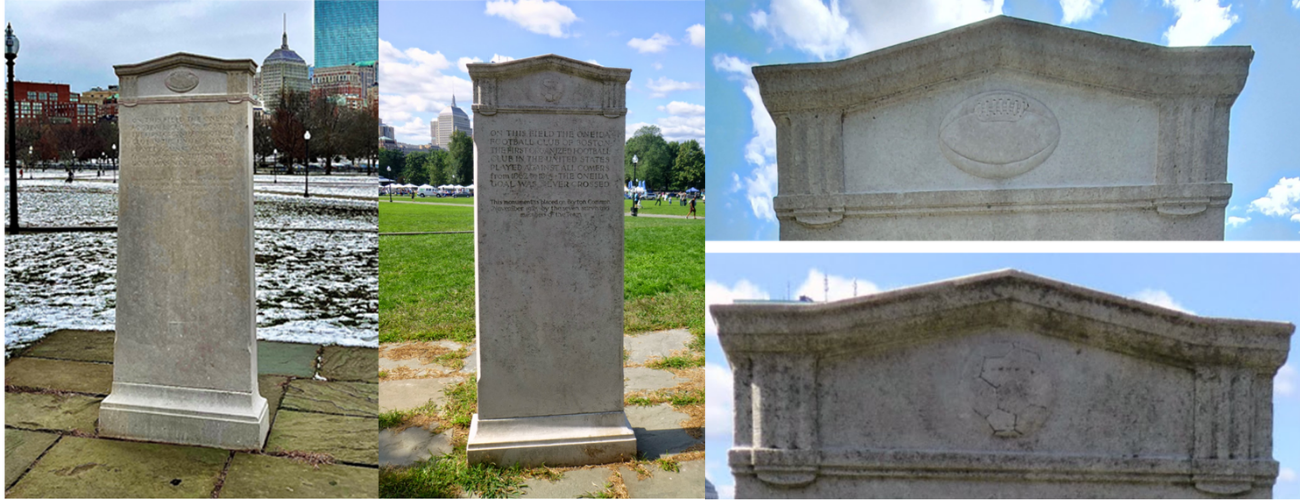
Another event in 1925 had shaped the Oneida monument—literally. The death of college football coach Walter Camp in March of 1925 stimulated a coast-to-coast memorial project to honor the sporting legend. The nation’s papers dubbed Yale the home of “the father of football,” which piqued Bostonian and Harvardian pride.6 In response, the Oneidas’ monument honored the city’s own “first organizers” of football (themselves) who played well before Camp ever walked on America’s fields. The seven survivors made a choice to engrave a 1920s-style college pigskin instead of the round ball they had kicked (and carried under specific circumstances).
It took time for their story to shape the national narrative, and Lovett’s scrapbook reveals that myth under construction. One short article from an unnamed paper in 1930 elevated the Oneidas as founders and distinguished their game which “contained elements of soccer, basketball, and the football we know today.”
A later two-column clipping recorded Lovett’s 90th birthday in the Boston Evening Transcript. It even featured a picture of their old round ball. Lovett claimed that the modern game (of 1934) had “too much pulling and hauling” in comparison to his youth, games “in those days terminating when one side scored a goal.”7 The nonagenarian passed away the following year. His daughter, Alice, preserved the scrapbook which ended with Lovett’s own obituaries.
The Soccer Grab
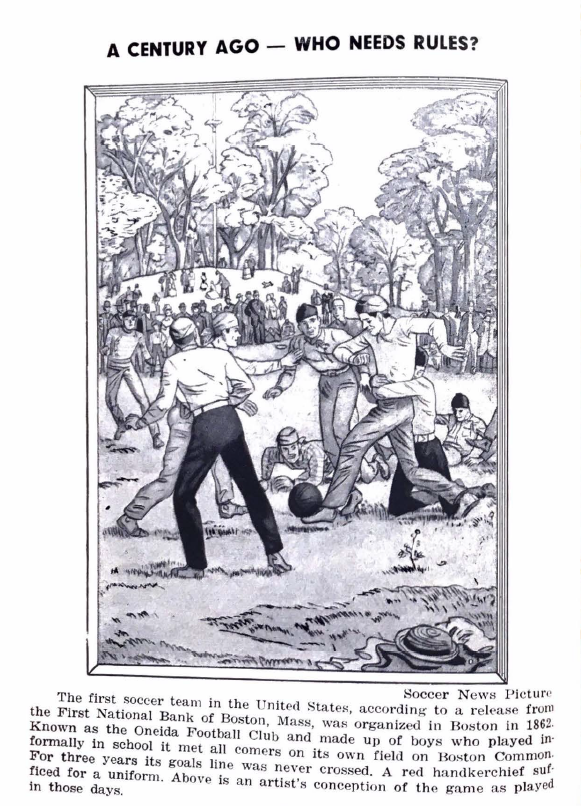
1962-63 US Soccer Annual – Graham Guide
Courtesy of the Society for American Soccer History (SASH)
The legend of the Oneida club grew. Thanks to its memory preserved on paper, in the SPNEA-displayed ball, and engraved in stone, the Oneidas were beginning to earn their place in the pantheon to oval-shaped collegiate football. However, their ball outlived them and by 1948 had been seen by a different football.
In postwar McCarthyism America, soccer was looking to shed its long-held mantle of being an immigrant game. By the eve of the United States soccer federation’s 50th anniversary in 1963, the Oneida boys had been adopted as its American genitors. So, when soccer enthusiasts came across an old round ball in a Boston museum, it suggested a different ancestry for a game hungry for its national origin story. By the 1980s, the National Soccer Hall of Fame (NSHOF) obtained the round Oneida ball on loan, as evidence of a long national tradition of kicking-style football in the city that founded—well—everything else in America.
Though, like a square peg in a round hole, a round ball did not fit into an oval story. After the successful 1994 World Cup that had raised soccer’s profile, the stone monument sorely needed refurbishing. In stepped the NSHOF, whose project proposed to re-carve the 1925 oval pigskin into a soccer ball, in rounder harmony with the club’s old plaything still on display in its soccer museum. That round memory remained engraved until yet another restoration project in 2014 changed the monument back to its original—and deliberately obscuring—intent.
Friendly Bragging Rights To the Ride of ‘75
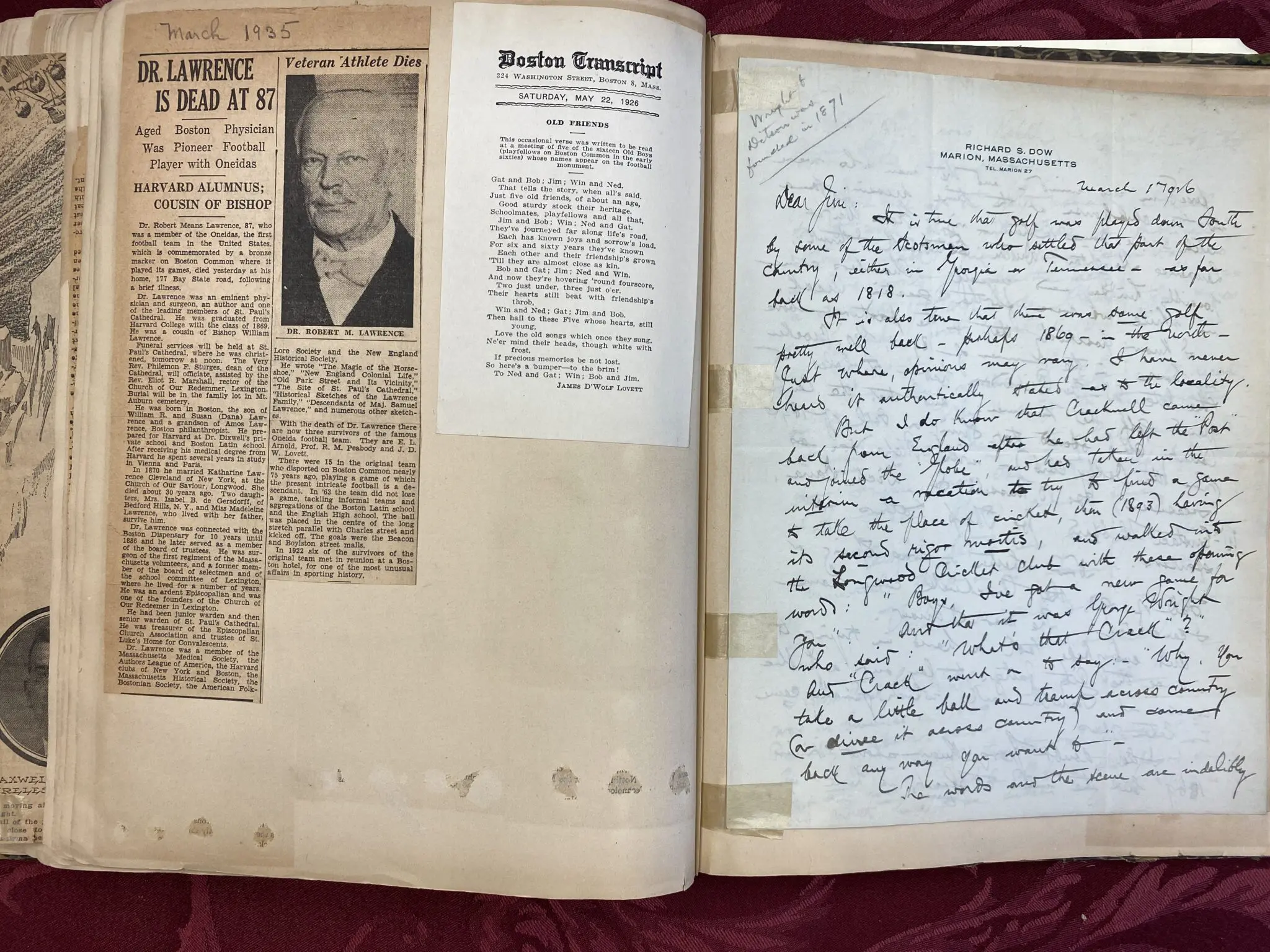
James D’Wolf Lovett scrapbook (detail), 1861-1945
MS0118
Collection of Revolutionary Spaces
In this year of Semiquicentennial celebration, when origins and national stories stir debate, the lessons from a sporting scrapbook can manifest more than just the forgotten games of youth. National identity, ownership of origin stories, and rivalry explain part of the story. And, claiming the sporting ancestry of the great-grandson of Paul Revere does undoubtedly help affirm a national “founding first.” But the mysteries hidden in the battle on the Common for sporting bragging rights reveal as much about the gamut of human sentiment as city and national history.
One of the final clippings in the scrapbook juxtaposes an obituary of club member Robert Means Lawrence and Lovett’s last known published poem. Entitled “Old Friends,” the verse extolls amity, the kind of which fueled the entire Oneida commemorative enterprise.
The Oneida club has borne two lines of sporting descendants over the years, both of whom claim to be the club’s only child. Ironically, during most of the Brady–Belichick era, the monument featured a soccer ball. But both times the World Cup has come to Boston—in 1994 and this summer—the monument’s oval football has hidden its rounder soccer cousin. So when you walk across Boston Common after a visit to the Old State House and Old South Meeting House, be sure to check the stone tablet to see which of the two football brothers is winning this monumental “founding first” tug-of-war. Maybe the two sports should call it a game and, in a spirit of friendship, share bragging rights to a sporting ancestor’s ride in April of ’75.
-
- “The Old Boys of Boston,” The Boston Sunday Herald, 24 June 1906, 8-9.
- James M. Lindgren, Preserving Historic New England: Preservation, Progressivism and the Remaking of Memory (New York: Oxford University Press, 1995).
- Abram C. Van Engen, A City upon a Hill (New Haven, CT: Yale University Press, 2020), ch. 13-16.
- “Oneida Football Team,” John Hancock Field, November 1923.
- “Round Robin,” signed on November 7, 1923.
- Roger Tamte, Walter Camp and the Creation of American Football (Urbana: University of Illinois Press, 2018), 303-9.
- “The Pulse: Looking back at ninety years,” The Boston Evening Transcript, 31 May 1934.
 Kevin Tallec Marston
Tallec Marston is CIES Senior Research Fellow and Visiting Lecturer at De Montfort University’s International Centre for Sport History & Culture (UK). He has taught for over twenty years on the FIFA Master, lectures at the University of Neuchatel (Switzerland), and serves as current president of the Society for American Soccer History (SASH)
Mike Cronin
“Inventing the Boston Game: Football, Soccer and the Origins of a National Myth” (UMass Amherst) was the honorable mention for the North American Society for Sport History (NASSH) 2025 Book award.