


The History of Black Congregants at the Old South Meeting House — Part Three
Written by Jim Bennett, Visitor Experience Supervisor
In the final installment of Revolutionary Spaces Visitor Experience Supervisor and historical interpreter Jim Bennett’s three-part series, we explore the potential advantages that come from church membership, as well as the hypocrisy of the congregation, and whether one outweighs the other. This comes after the previous Boston Reconsidered blog post which detailed the justifications the congregation had for keeping enslaved people in the first place.
A life Dedicated
In 1726, an enslaved man named Cornwall stood in the broad alley at the front of Old South Meeting House and was baptized. As he was an adult, he agreed at his baptism to “own the covenant,” which meant that he would live under the discipline of the church. Nearly 15 years later, in 1741, during the heady days of the Great Awakening, Cornwall once again stood before the people of Old South Meeting House, made a public relation of faith, and became the 13th person of color to be accepted into the full communion of the church. After years of spiritual devotion, he was now recognized as one of the visible saints of the community. Yet he was still enslaved. By chance, the sermon that Old South Meeting House pastor Joseph Sewall preached on the day when Cornwall made his statement of faith has come down to us. Sewall, perhaps inspired by the testimony of this enslaved man, made clear that the freedom the church offered the enslaved would not be from human bondage:
Nor shall I forbear to exhort our Indians and Negroes to submit to Christ, and stand on his Side. Your Names indeed are not reckoned in our Muster-Rolls; but tho’ our Lord needs none, he alone is able to subdue the Enemy, and whatever Instruments are used by him, his is the Power and the Victory; yet I say, He condescendeth to accept the Service of the meanest, who are willing heartily to espouse his Cause. Now then, that God has bro’t you out from the dark Places of the Earth, where Satan had his Seat, to a Land of Gospel-Light, where it is declared that the Son of God was manifest in the Flesh, and hath redeemed a People to God by his Blood, out of every Kindred, and Tongue, and People, and Nation; seeing this is the happy State of Things, despise the Slavery of the Devil, shake off the Chains of Darkness in which you have been bound, and cry to your Saviour, that you may be delivered from the Bondage of Corruption, into the glorious Liberty of the Children of God. Come over to Christ, and you shall also overcome, and sit down with him on his Throne.1
Sewall’s message to Cornwall and to the other enslaved people at Old South Meeting House on that day was pointed: the only bondage that the church would help them to escape was that imposed by Satan, and they should be thankful for that opportunity. Church membership was not a path to freedom from slavery in this world.
Benefits of the Church
Historians have often insisted that church involvement in the colonial period carried potential benefits for the enslaved. The life trajectory of Cornwall, an exemplary enslaved Christian, provides a case study on both the possibilities and limitations of those benefits. Just one month before making his relation of faith, Cornwall was married to Katherine, an enslaved woman. Such a marriage required the consent of Cornwall’s enslaver, Captain John Ellery, and Katherine’s enslaver, Joshua Winslow, Esq. Both enslavers were congregants at Old South Meeting House, and the couple were married by Pastor Joseph Sewall. Without the network of relationships among both enslaved and enslavers at Old South Meeting House, their marriage would not have been possible.
Captain John Ellery died a year later, in July of 1742. His will stated “I hereby order that my negro man servant named Cornwall have his freedom immediately after my decease.”2 Not long after, Katherine likewise became free, although how she obtained her freedom is unrecorded. Cornwall and Katherine were now able to start a family as free people. They continued their association with Old South Meeting House. Cornwall’s baptism years before meant that he would be allowed to present his own children for baptism at Old South Meeting House. Over the next several years, Cornwall and Katherine presented four children for baptism: Katherine, Prince, Joseph, and Lucy.
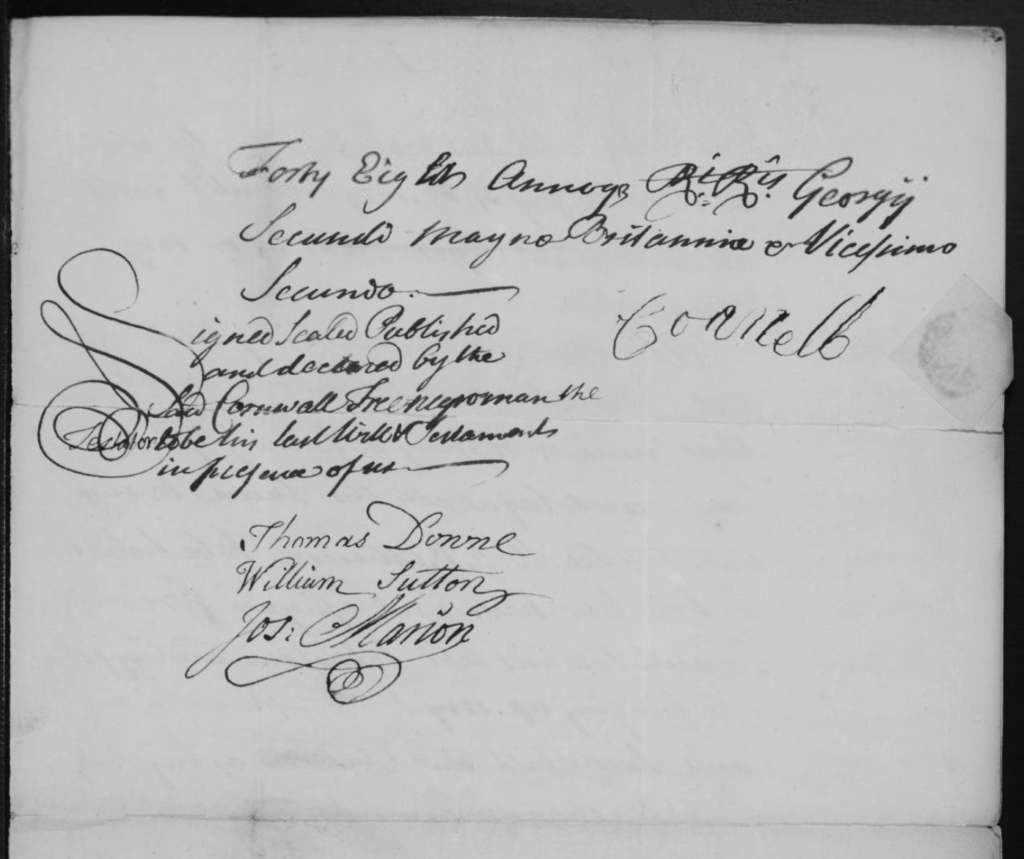
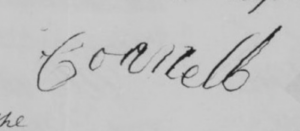 Unfortunately, this story would not end happily. By late 1748, Cornwall was dying. Historians have argued that church involvement in New England, if nothing else, provided an opportunity for the enslaved to become literate. Cornwall’s last chapter provides evidence for that contention, as he composed one of the only wills ever registered by a free Black man in colonial Boston, and signed it in his own hand:3
Hypocrisy
Cornwall had so little property at the time of his death that nothing was itemized in the will. He wrote that after the payment of his funeral expenses, the remaining money should be used for “subsistence and support and bringing up my boy Joseph an infant and such child and children as my wife Katherine may have by me.” This statement tells us that their first children, Katherine and Prince, had been lost to them, and that Lucy had not yet been born.
As a young widow of a long-standing full church member with two young children in her care, Katherine must have been a sorry sight at Old South Meeting House on Sundays, which makes the church’s lack of charity to her all the more perplexing. About 10 years after Cornwall’s death, in 1758, Old South Meeting House’s financial records state that 18 shillings were disbursed to “the widow Cornwall,”4 which made her one of only three Black people in the colonial period to receive money from the coffers of Old South Meeting House. In contrast, white widows at Old South Meeting House frequently received semi-annual payments from the church for the remainder of their lives, sometimes for decades. From 1708 to 1775, the total contribution of the church to Black people in need totaled £2 2s 14.5d (two pounds, two shillings, and fourteen and a half pence). Many white indigent congregants received more than that amount on a single occasion.
Reflection
In the end, did Cornwall and his family benefit from their relationship with Old South Meeting House? We can safely say that Cornwall learned how to read and write his own name because of the church’s stance that the enslaved should be taught to read. He likely met his wife there. His church involvement may have meant quite a lot to him spiritually, and it may have caused his enslaver to treat him more humanely and arrange for his eventual manumission, but both of these propositions must remain speculative. Following the tragedy of his premature death, the congregation did nearly nothing to provide for his family, as was the case for all free Black members of the church. Charity at Old South Meeting House during the colonial period stopped at the color line.
This is the final blog post in the series, but it is not the end of the road in terms of this research. There is always more to discover and Revolutionary Spaces is dedicated to remembering and honoring all of its congregants, regardless of the color of their skin. In reviving their stories, we hope to give voices back to the Black and Indigenous people who once worshipped in these halls.
- Joseph Sewall, The Holy Spirit Convincing the World of Sin, of Righteousness, and of Judgment, Considered in Four Sermons: The Two Former Delivered at the Tuesday-Evening Lecture in Brattle-Street, January 20th & March 3: The Other at the Old-South Church in Boston, April 17 & 26, 1741 (Boston, 1741), 130. Accessed on Evans Early Imprints, University of Michigan.
- Suffolk County, MA, Probate File Papers, case 7781. Accessed on americanancestors.org.
- Suffolk County, MA, Probate File Papers, case 9153. Accessed on americanancestors.org.
- Sacramental Contribution, 21r. Congregational Library Manuscript.