


How to Solve a Problem Like Samuel: Colonial Provisions for the Mentally Ill
By Kate LaPine
Published: May 2026
Find out how colonial Massachusetts towns tried (or didn’t try) to take care of their citizens with mental illness
Revolutionary Spaces is collaborating with the National Museum of Mental Health Project to share the story of James Otis Jr., a Massachusetts patriot who lived with a mental health condition. This post is part of a series of blogs that supplement the online exhibit, Patriot, Hero, Distracted Person: James Otis, Jr. and Mental Health in the Eighteenth Century.
In colonial Massachusetts, most cases of mental illness were handled discreetly by families, often with minimal documentation. As a result, many “distracted” individuals left little trace in official records, largely because if they were being cared for at home, they avoided contact with authorities.
There are some exceptions. Wealthy individuals like James Otis, Jr. appear in court archives, and their struggles are preserved alongside legal proceedings. When Otis’ behavior became concerning, his family pursued formal intervention. Boston’s selectmen declared him non compos mentis (not of sound mind), and appointed a guardian to manage both his care and his estate. Otis’ case, while well known, is the exception rather than the rule.
Town records, by contrast, contain references to the “pauper insane,” individuals who relied on limited public safety nets for the poor. In these cases, local officials often engaged in what can best be described as a game of bureaucratic hot potato—passing responsibility from one jurisdiction to another to avoid being saddled with the cost of their care.
To understand how this worked in practice, we turn to Samuel Coolidge (1703-1767), whose life provides a particularly vivid case study. According to Sibley’s Harvard Graduates, Coolidge’s story traces a long and difficult path from promise to poverty.1 For nearly 40 years, the Watertown, Massachusetts schoolmaster was prone to wandering and disorderly conduct, prompting town leaders to deploy every available strategy—some compassionate, some less so—to manage his care.
A Promising Puritan
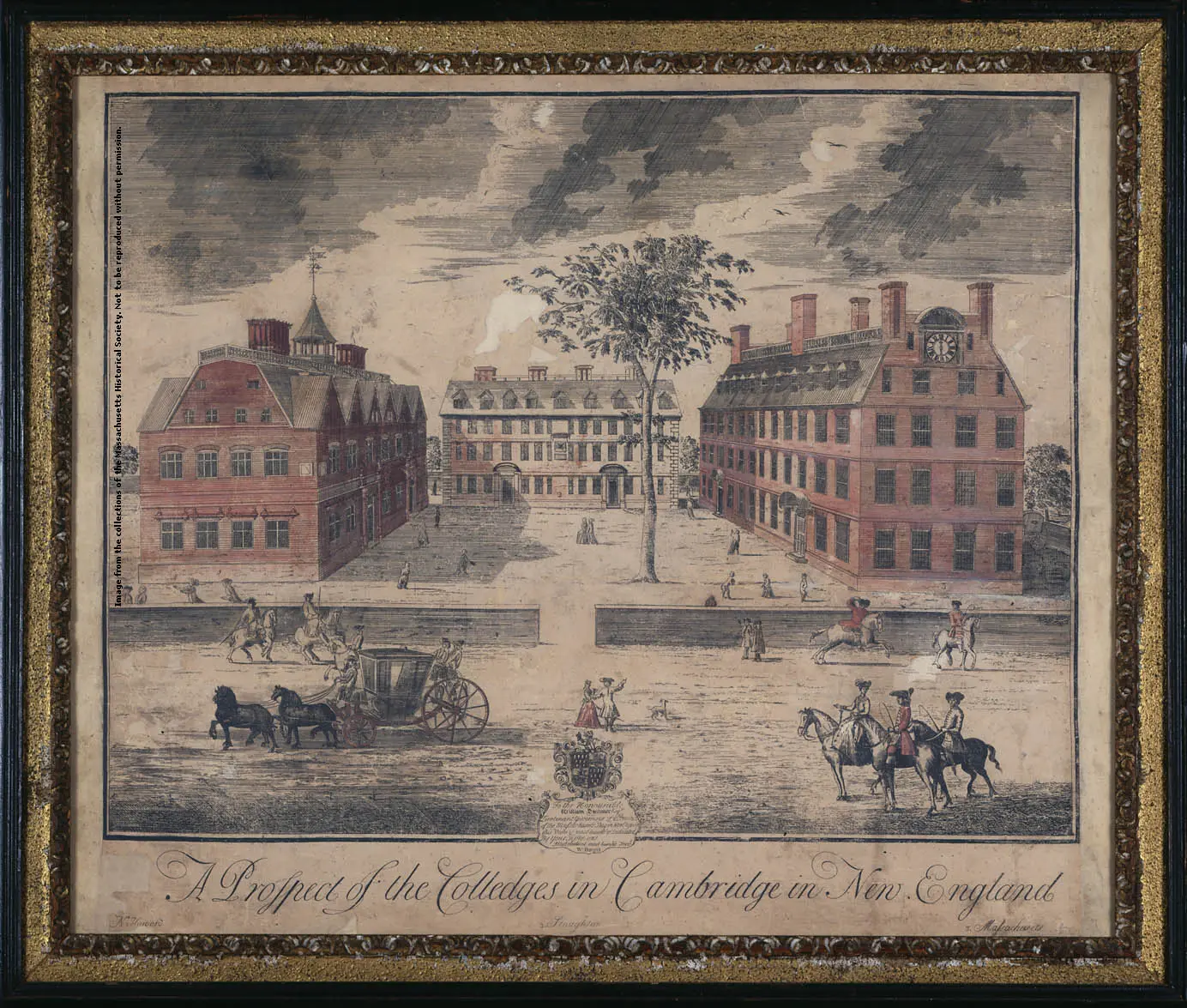
When Coolidge graduated from Harvard in 1724, expectations were clear: every individual had a role to play in building a stable and prosperous society. The Puritans believed in the importance of a “calling”—contributing according to one’s ability—and idleness was not just frowned upon, it was practically a moral failing.2 Men like Coolidge who were trained as ministers at Harvard College were expected to serve the community either as clergymen or by teaching school.
Coolidge got off to a strong start. At 19, he began teaching in Watertown, earned his Master of Arts, and spent several years preaching in “frontier pulpits” in Massachusetts and Connecticut. By 1733, he had returned to Harvard, where he was recognized as an “expert in Tully’s orations” and rewarded with the post of college librarian.
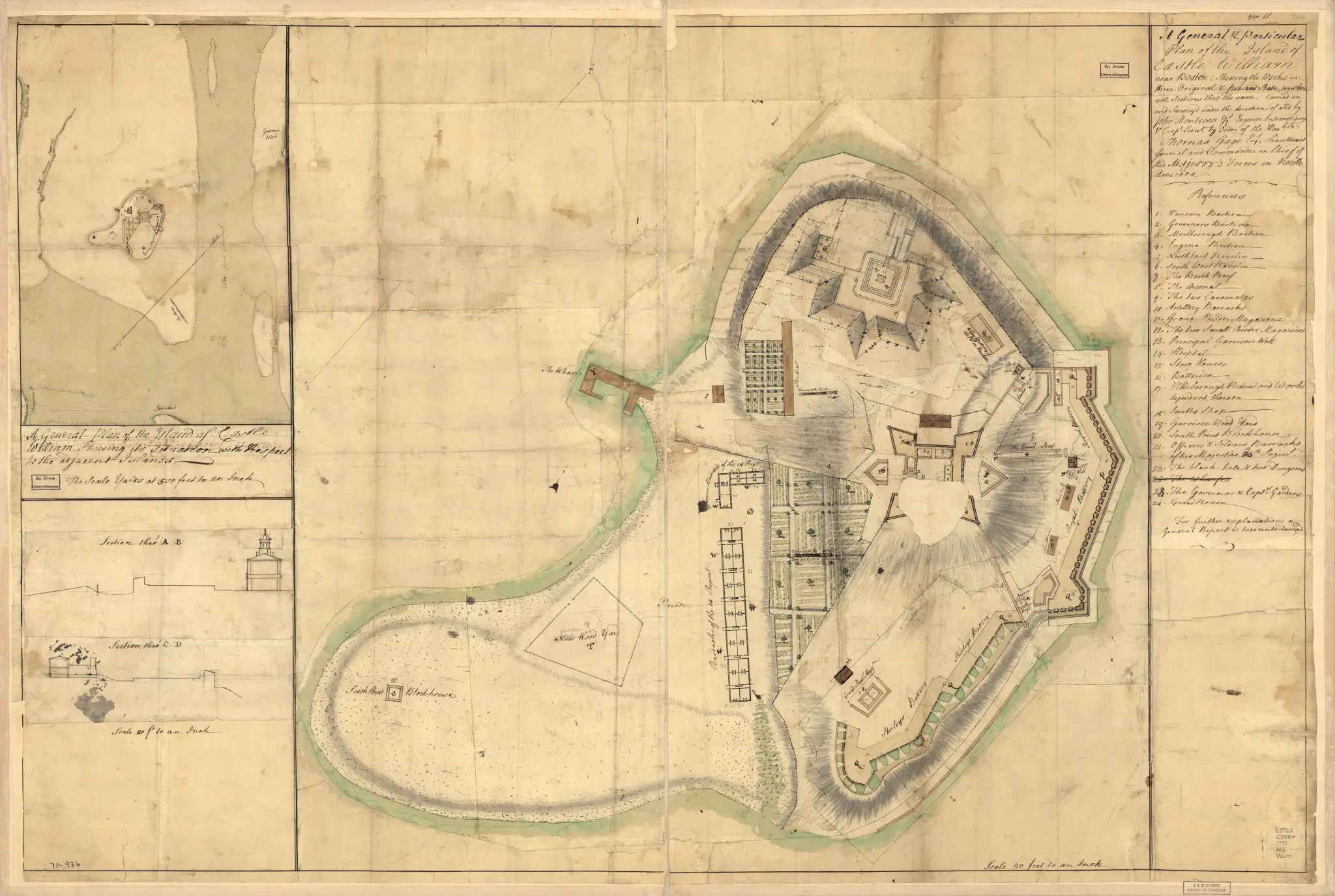
But stability proved elusive. After a series of short-lived positions—including a stint as chaplain at Castle William—Coolidge was struggling to fulfill his duty as a productive member of society. His posts ended one by one as he took to wandering the streets of Boston and Cambridge, exhibiting behavior described at the time as “distracted.” Authorities, unsurprisingly, took notice.
Banned From Campus
By 1742, Coolidge’s behavior had worn thin with Harvard’s leadership. Increasingly impaired, he was accused of acting like a “Vagabond,” engaging in drinking, cursing, and general disruption. After “rude & indecent Behaviour at Divine Worship” and attempting to enter students’ rooms, he was officially forbidden to associate with anyone at the college.3
Warned Out
That same year, Boston’s selectmen also decided they had seen enough. Concerned that Coolidge might become a financial burden—a “Town Charge”—they exercised a legal option known as “warning out,” effectively telling him to take his troubles elsewhere. It was less a solution than a relocation strategy.
Complaint being made by mr. Cook that mr. Samuel Coolidge formerly chaplain of the Castle is now in this Town & in a Distracted Condition & very likely to be a Town Charge, Voted, that mr. Savell Warn him out of Town according to law.4
Whose Responsibility? And Whose Dime?
Sixty years before Coolidge attracted attention, the Massachusetts General Assembly passed a law requiring each town to control its mentally ill residents so that “they doe not damnify others.”5 A subsequent 1694 law, “An Act for the Relief of Idiots and Distracted Persons,” stipulated that before the town stepped in to care for someone, it must make sure that “no relations appear that will undertake the care of providing for them.”6
There is little mention of Coolidge’s family in Sibley’s Harvard Graduates. He was the fifth son of Richard and Susanna Coolidge and stayed “alternately with his brothers John and Nathaniel” in the winter of 1749-50. But their ability—or willingness—to support him was limited and eventually, Coolidge became dependent on town assistance, illustrating the gaps in both family and public support systems.
Sanity Determined by Selectmen
The 1694 law required that selectmen in towns with “unruly Distracted persons” ensure that they do not disturb the peace and that the town manage their estates “in Times of their Distemperature.” In 1736, a new provincial law granted town selectmen—hardly medical experts—the power to determine mental incompetence.7 Financial competence often served as the primary benchmark for determining mental competency.
For those individuals who were declared non compos mentis and unable to manage their financial affairs, officials appointed a legal guardian.8
Watertown’s Town Charge
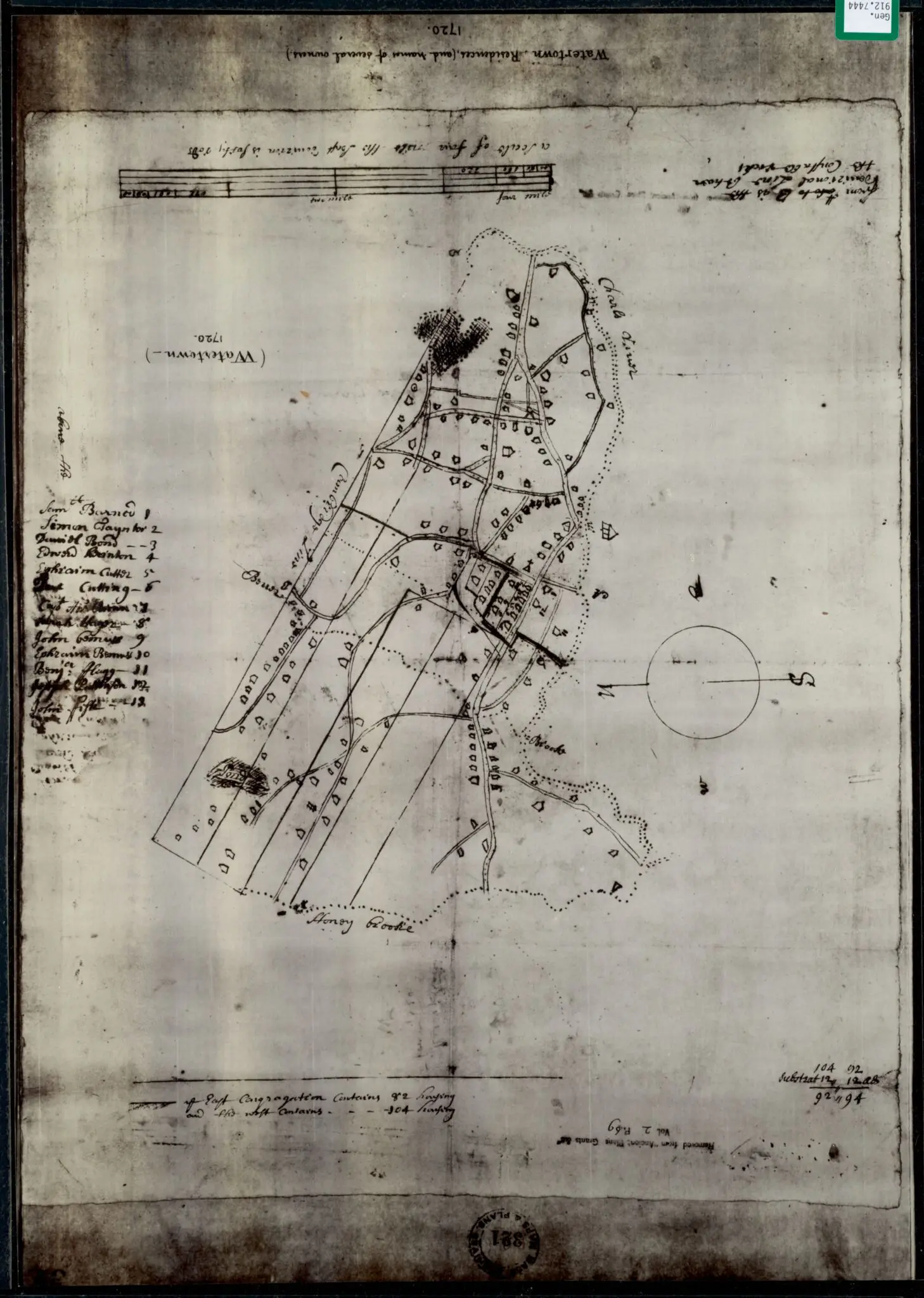
Having been banished from Boston and Cambridge, Coolidge became “a familiar and pitiful sight in Watertown.” Each winter, the town provided clothing and occasional support, hoping he might regain stability and prove himself useful. He was even reappointed as a schoolmaster at times, though these arrangements rarely lasted: “being far gone in Despair, sordidness and viciousness (viz. Idleness and sloth, Smoaking & Drinking).”9
Town records reflect a mix of concern and frustration. The selectmen responded to complaints “that he is in Danger of Suffering” and “out of Humanitie towards him under his Necessitous Circumstances think themselves Obliged to Do Some thing for him at the Towns Cost.” Officials purchased shoes, stockings, coats, and other necessities, while gently (and repeatedly) encouraging Coolidge “to git in to Some way of business”—a goal that proved easier to suggest than to achieve. November 1749 brought Coolidge back to Watertown “in a Suffering Condition … being Destitute of every thing of Clothing fit to cover his Nackedness.”
Boarding Out
Efforts to house Coolidge met with mixed success. Though placed with various families at town expense, he often returned to wandering—sometimes preferring barns over beds. One host family lasted just two weeks before concluding that the arrangement was untenable and making Coolidge the town’s problem once again. This practice, known as “boarding out,” was more common among wealthier individuals, whose families could pay for care. For those like Coolidge, options were more limited and far less stable.
Institutions for the Poor & Mentally Ill
In 1750, having exhausted other options, Coolidge was thrown into the town jail, from which he promptly escaped. The selectmen then tried sending him to the Boston workhouse, agreeing to reimburse the cost of “what his Labour will not Answer.”
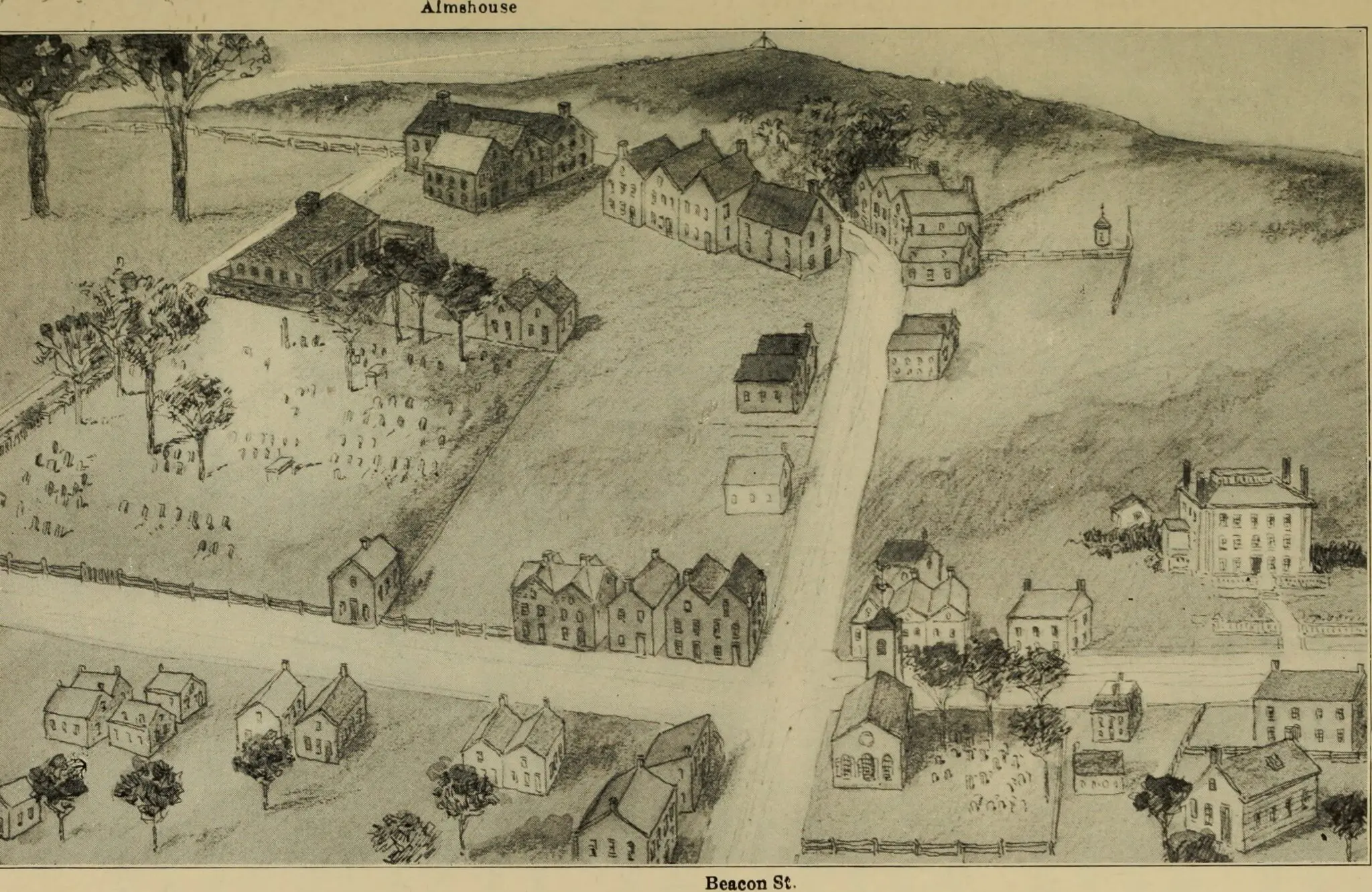
Courtesy Wikimedia Commons
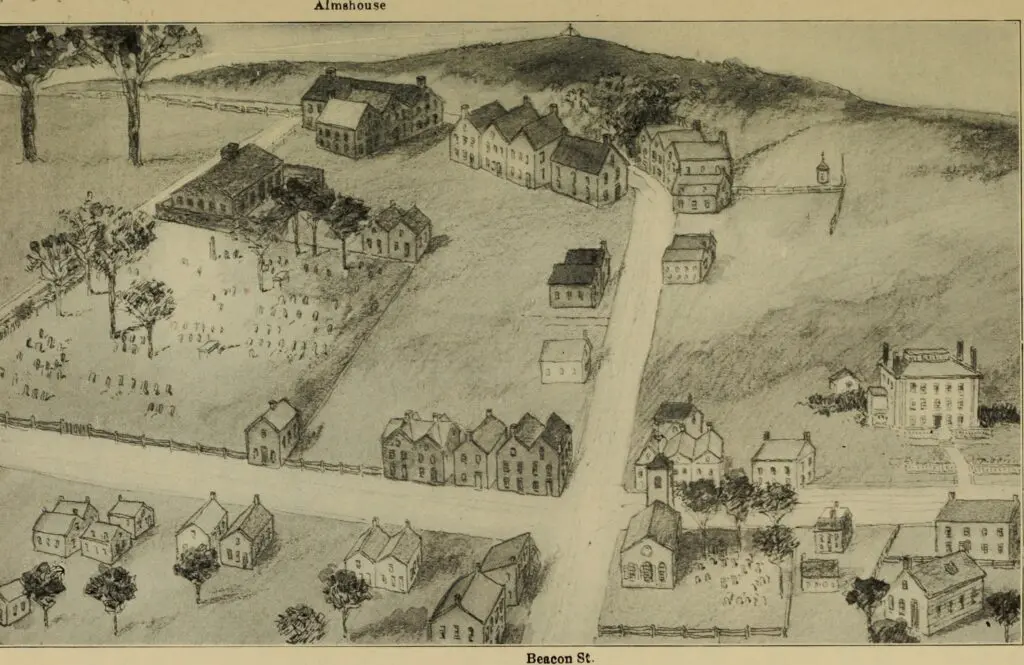
Because Samuel Coolidge was not a Boston resident, he was not eligible to enter the Boston Almshouse like other paupers with mental illness. Boston had first established a poorhouse for its impoverished residents in 1662. Following a fire, the Almshouse was rebuilt on the corner of Beacon and Park Streets in 1696, the first of several buildings for the city’s less desirable characters. In 1729, a bridewell prison was opened for petty offenders including vagrants and disorderly women, and in 1739, a workhouse was added to the property.10
With no specific institution for the mentally ill, “distracted” individuals appeared on the rolls of all these sites, indistinguishable from other paupers.11 By 1729, Boston’s selectmen considered but did not approve “making some addition to the Almshouse for keeping distracted persons separate from the Poor.” In 1746, the overseers of the poor proposed that “the Town purchase the Bridewell house &c. for a mad house,” which was voted down. And in 1751, they complained that the workhouse was not self-sustaining because of the number of “distracted, helpless and infirm people there.”12

Although Thomas Hancock’s will directed the town to build a “mad house” in 1764, Boston would not have a dedicated municipal institution for treating the mentally ill until the Boston Lunatic Hospital was established in 1839. John Singleton Copley. Courtesy Wikimedia Commons
Hancock’s Hospital
Aware that Boston lacked a suitable venue for distracted persons, the wealthy merchant Thomas Hancock took it upon himself to remedy the situation. In his later years, this uncle of John Hancock appears to have suffered from nervous disorders, making him sympathetic to the plight of the less fortunate mentally ill. Hancock’s will stated that the building (to be called Hancock’s Hospital) would be for “the reception and more comfortable keeping of such unhappy persons as it shall please God in his Providence to deprive of their reason.” When he died in 1764, he left £600 to Boston to build a “mad house” within three years of his death.
Despite this generous bequest, £600 was insufficient and the town attempted to raise additional funds to carry out Hancock’s wishes. Coincidentally, James Otis served on the committee which petitioned the provincial Assembly for financial aid in 1766. Ultimately, Hancock’s Hospital never came to fruition as the Assembly denied the request stating, “There are not enough insane persons in the province for the erection of such House.”13
Watertown’s Burden
With few options remaining, Watertown continued to manage Coolidge’s care as best it could. The town remained optimistic that Coolidge would improve enough to teach school and might “in some measure Earn his Living.” At times, he was allowed to live independently; at others, more restrictive measures were imposed—including, at one point, being chained for safety until he was in “his right Mind so as to be Serviceable again.”
When Coolidge died in January 1767, the town arranged a funeral for the 64-year-old school master. The selectmen then took an inventory of his possessions and “closed his account by selling what remained of the things which the town had bought for him.” It was a practical, if somber, conclusion to a long and difficult life.
-
- Clifford K. Shipton, Sibley’s Harvard Graduates: Biographical Sketches of Those Who Attended Harvard College in the Classes 1722-25. (Boston: Massachusetts Historical Society, 1933–), Vol. 7, pp. 326-331. https://babel.hathitrust.org/cgi/pt?id=pst.000025231625&seq=372&q1=samuel+coolidge
- Carrie Conaway. “Like Father, Like Son” Federal Reserve Bank of Boston, March 1, 2003. https://www.bostonfed.org/publications/regional-review/2003/quarter-2/like-father-like-son.aspx
- Harvard Faculty records, 1, 177-8, cited in Sibley’s p. 328
- Deutsch, Albert. The Mentally Ill in America: A History of their Care and Treatment from Colonial Times. Cambridge University Press: New York (1949). P. 45 (Boston’s Selectmen’s Minutes, V. 15, p. 364)
- Albert Deutsch. “Public Provision for the Mentally Ill in Colonial America,” Social Service Review, Dec, 1936, Vol. 10, No. 4, p. 610, https://www.jstor.org/stable/30010753
- Massachusetts General Court, The Charters and General Laws of the Colony and Province of Massachusetts Bay. “Chapter XXVII: An Act for the Relief of Idiots and Distracted Persons.” https://archive.org/details/chartersgenerall00mass/page/276/mode/1up
- The Charter and General Laws of the Colony and Province of Massachusetts Bay, 1634-1779 (Boston, 1814), pp 516-517. https://archive.org/details/chartersgenerall00mass/page/514/mode/2up
- Guardianship
Despite his Harvard education, Samuel Coolidge was impoverished. For those more financially secure with property (like James Otis, Jr.), the Colony of Massachusetts initiated the legal process of “Guardianship” to protect their well-being and property, naming a legal guardian to manage the distracted person’s financial affairs. The arrangement was designed to prevent fraud and protect the incapacitated person from embezzlement. The guardian was paid for his service out of the estate while he had to offer a significant bond to the court to ensure his integrity. - Ebenezer Parkman diary, September 8, 1744, cited in Sibley, p. 328
- “The Boston Almshouse.” Primary Research. https://primaryresearch.org/the-boston-almshouse/
- Albert Deutsch. “Public Provision for the Mentally Ill in Colonial America,” Social Service Review, Dec, 1936, Vol. 10, No. 4, p. 610, https://www.jstor.org/stable/30010753
- Jimenez, Mary Ann. Changing Faces of Madness, pp. 55-56
- Boston Town Records, March 25, 1765, V. 16, pp. 139-40.
 Kate LaPine
A lifelong student of history, LaPine first learned about James Otis, Jr. and mental illness in Colonial Massachusetts as a member of Revolutionary Spaces’ visitor experience staff. She brings decades of communications and project management experience to her work as an independent museum professional.