

Boston Tea Party 252nd Anniversary Commemoration
Tuesday, December 16, 2025
Reenactment of the Meeting of the Body of the People
On one fateful night in December 1773, a cry for liberty echoed through the Old South Meeting House—now, 252 years later, the spirit of revolution rings through Boston once more. Commemorate the 252nd anniversary of the Boston Tea Party with an unforgettable live reenactment of the Meeting of the Body of the People—held in the very room where it all began.
Feel the tension rise as fiery patriots debate the fate of the East India Company’s tea before thousands of restless colonists. Hear the shouts, the arguments, and the call for action that set a revolution in motion. Watch history come to life as your favorite Revolutionary figures, like Samuel Adams, John Hancock, and Paul Revere, grapple with the decision to take bold action against British tyranny, ultimately leading to the dramatic and historic event that became known as the Boston Tea Party.
Join Revolutionary Spaces for an evening of powerful performances, immersive storytelling, and patriotic spirit as we bring December 16, 1773, vividly to life once more. Experience history where it happened—and be part of Boston’s most electrifying annual tradition.
Please note: Your ticket includes general admission to the Meeting of the Body of the People at Old South Meeting House. Boston Tea Party Ships & Museum will not host the reenactment of the destruction of the tea in Boston Harbor this year.
Purchase Tickets
What to Expect
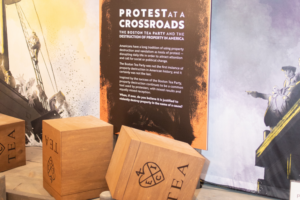 Free Admission to the Old State House and Old South Meeting House
Your ticket also includes FREE museum admission to both of Revolutionary Spaces’ sites—the Old State House and Old South Meeting House—from Wednesday, December 17th through Sunday, December 21st (a $15 value)! Be sure to explore our exhibit Impassioned Destruction: Politics, Vandalism, and the Boston Tea Party for a more in depth exploration of the impact this historic event had on other moments throughout history. This exhibit closes at the end of the year—don’t miss your chance to experience it before it’s gone!
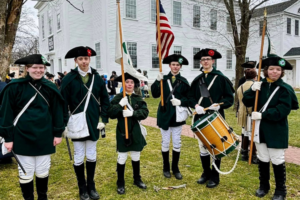 Performances from Middlesex County 4-H Fife & Drum Corps
Joining us prior to the event is Middlesex County 4-H Fife & Drum Corps. Formed in 1972, MC4HFD is the original junior level fife and drum corps of Massachusetts. Before coming inside Old South Meeting House, be sure to watch their rousing performance in the Downtown area.
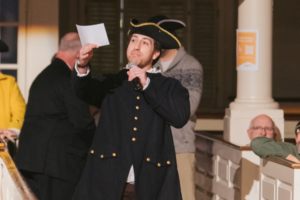 Be A Part of Our Founding Story
Make your voice heard! Audience members will have the unique opportunity to step back in time and actively participate in the debate. Feel the passion and tension of that night 252 years ago by standing before the crowd as a Loyalist defending British rule or a Patriot advocating for independence.
Event Policies & Accessibility
To ensure a safe, enjoyable, and inclusive experience, please review our policies and reminders before attending. Please click the button below to review important information on admission, accessibility, prohibited items, and our commitment to maintaining a respectful environment for all guests.
The entrance and Main Hall of the Old South Meeting House are wheelchair accessible, and a limited number of handicap accessible seats are available. Please email ticketsales@revolutionaryspaces.org to request a handicap accessible seat for you or someone in your party. Restrooms and the museum store are located on the lower level and can be accessed via elevator.
Corporate Partners
Thank you to our corporate partners!








LEARN MORE ABOUT THE BOSTON TEA PARTY
Meet the Characters
Timeline of the Boston Tea Party
Loyalists vs. Patriots
If you are a LOYALIST, you might argue...
Even with the tea tax, the tea is cheaper than it has ever been before! It is even cheaper than the smuggled Dutch tea available in the colonies.
The tea tax is minimal! It is the only tax remaining out of many that were passed by Parliament in the 1760s. All other taxes were rescinded when they proved ruinous to the colonies; the three pence per pound tax can hardly be termed ruinous!
Taxation is the right of every government! Taxes have always existed and will always exist!
All Englishmen pay taxes! Along with the rights and privileges of being an Englishman comes the duty and responsibility of paying taxes.
This tax strengthens our relationship with England and the Empire and benefits us directly! We receive the protection of the British military—the strongest military force in the world! This military force protected us from French attempts to take the colonies in the French-Indian War. British troops protect us as well from native peoples who are still allied with the French, and who continue to terrorize us along our frontier borders. The tax pays for administrators to run the colonies. As part of the British Empire, we maintain a special trade status; we receive the highest quality of goods from England, and are able to trade with all areas of the Empire with few import duties.
We are all Englishmen, and are represented in Parliament. It is unreasonable to suggest that colonists are not represented in Parliament. It is well known that Parliament does not provide for geographic representation, but that there is virtual representation! Virtual representation states that the members of Parliament spoke for the interests of all British subjects rather than for the interests of only the district that elected them. Entire cities in England—Leeds, Manchester, Birmingham, and Liverpool—do not have representation! Mr. Franklin and others in England convey our ideas and needs to Parliament. Besides being treasonous, the talk of breaking up the Empire is unreasonable. Locke wrote that only an unresponsive government should be overthrown; Parliament has proven to be responsive by rescinding taxes and other policies that the colonists objected to. There should be no loose talk about leaving the Empire.
The East India Company is a beneficial monopoly. The tea is cheaper now because Parliament is helping the East India Company remain solvent. Were the East India Company to go bankrupt, it could cause widespread economic depression throughout the Empire.
If you are a PATRIOT, you might argue...
Despite its small amount, the tea tax is outrageous. The tax pays the salaries of administrators, most of whom are foreign-born, to run our government. They have no responsibility or loyalty toward the people whom they govern. They are unaware of local needs, not used to our local customs, and insensitive to our local talents! It is not the amount of the tax, but the principle. Other outrageous taxes were enacted in the past and were proven to be ruinous. This tax is no different!
The tax creates a monopoly. Only seven men control the selling of tea in Boston. If this monopoly is sustained, what will be next? Iron? Lead? Paint? Glass? Merchants will be driven out of business! The tax is simply to provide revenue to keep the East India Company afloat! The restrictive taxes have hampered merchants by forcing them to do business outside of the Empire, in some cases forcing them to become smugglers to stay in business!
The colonies are an important part of the Empire. We are an economically important colony, but are not treated as such. American colonial free trade with other countries will enrich and strengthen the Empire as a whole. Parliament must think in the long term. We are Englishmen in America, and are reputed to have the rights of Englishmen, but these are not respected.
The colonies are not represented in Parliament. There is no opportunity for our ideas to be expressed in Parliament. We have no say in how and on what we are taxed. We have been forced to govern ourselves for over 100 years due to Imperial neglect, and now the war debts suddenly make them remember, regulate, and tax us!
The soldiers in Boston are a menace to us! They have always contributed more to the unrest than to the peace. (Remember the Boston Massacre?!) The presence of soldiers was forced on the people of Boston, and not requested by the assembly. Why pay for unwanted tormentors?